
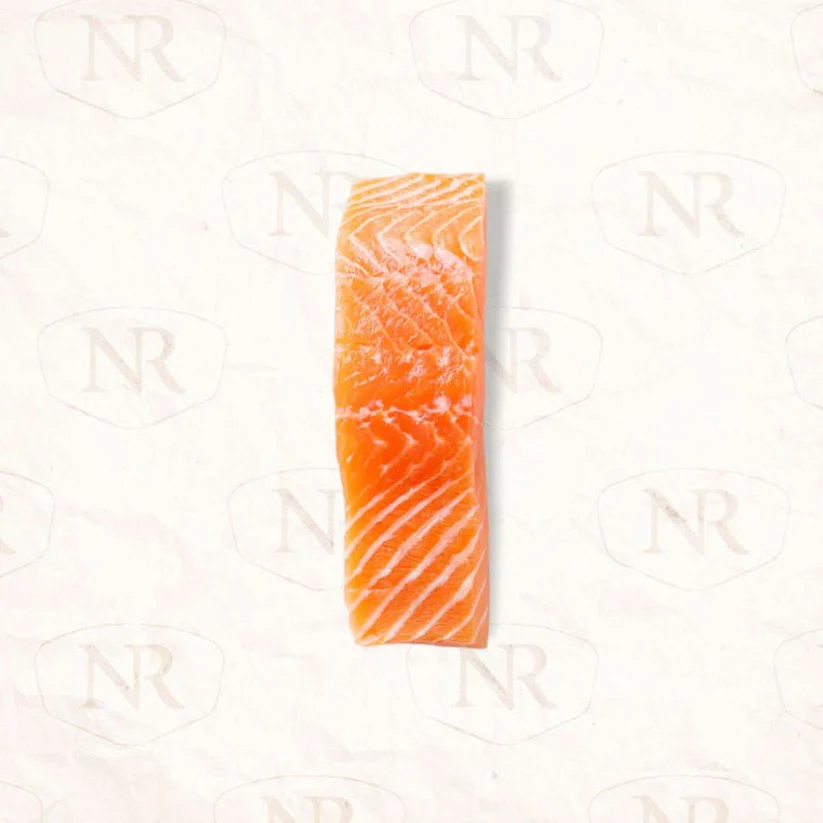
Northern Raised’s wild salmon portion delivers wild-caught flavour that farmed fish cannot match — firmer flesh, deeper colour, and a clean ocean taste. This guide covers five steps to cook it perfectly: thawing correctly, patting dry, seasoning simply, hitting the right pan temperature, and resting before serving. Follow these steps and you get a golden crust, moist interior, and none of the chalky, overcooked texture that ruins most home-cooked salmon in 2026.
Wild-caught salmon from Canada is one of the most flavour-dense proteins you can put on the plate — but it punishes bad technique. The flesh is leaner than farmed Atlantic salmon, which means it overcooks faster and dries out at margins most cooks don’t expect. Get the method right, though, and the result is noticeably better than anything from a standard grocery counter: a clean mineral flavour, firm-but-yielding texture, and a sear that holds together when you flip it. This guide works for skin-on portions around 150–200 g, which is the standard cut you receive from Northern Raised.
What You’ll Need
- Wild salmon portions — skin-on, 150–200 g each (Northern Raised wild salmon portion, thawed)
- Cast iron or stainless steel skillet — 25–30 cm diameter
- High smoke-point oil — avocado oil or grapeseed oil (smoke point above 200°C)
- Paper towels — critical for moisture removal before searing
- Instant-read thermometer — target internal temp 52–55°C for medium
- Sea salt and black pepper — coarse grind
- Neutral butter or lemon — for finishing
- Resting rack or plate — rest the fish off direct heat for 2 minutes post-cook
- Time: 25 minutes total (15 minutes thaw prep + 10 minutes active cook)
Step 1: Thaw the Portion Correctly
Thawing directly in warm water or on the counter at room temperature introduces the single most common failure point in cooking wild salmon at home. Rapid or uneven thawing begins cooking the exterior proteins before the interior has warmed, producing that chalky, opaque outer layer even before the pan touches the fish.
Place the vacuum-sealed Northern Raised wild salmon portion in the refrigerator overnight — 8 to 12 hours is ideal. If you need same-day thawing, submerge the still-sealed bag in cold (not warm) water for 20–30 minutes, changing the water once at the halfway mark. The portion is ready when it bends slightly under gentle pressure with no frozen core.
Never microwave-thaw wild salmon. Microwave defrost cycles heat unevenly and begin denaturing the proteins at the thin edges while the thick centre stays frozen.
Expected outcome: A fully thawed portion that is cold (around 4°C), firm, and pliable — not room temperature and not stiff.
Common mistake: Leaving the portion on the counter for 30–60 minutes. Even at 20°C ambient temperature, the outer millimetres of the fillet begin to cook, killing the texture before the pan is hot.
Step 2: Dry the Surface Completely
Moisture on the surface of the fillet prevents the Maillard reaction — the browning process that creates crust and flavour. Steam forms when surface water hits hot oil, and steam is the enemy of a sear.
Remove the thawed portion from its packaging and press both sides firmly against several layers of paper towels. Hold for 10 seconds per side. Repeat with fresh towels. The skin side needs particular attention: run a towel along the skin and press into the scoring lines if the skin is cross-hatched.
Season immediately after drying — coarse sea salt on both sides, black pepper on the flesh side only (pepper on skin burns and turns bitter). Season 3–5 minutes before the pan, not 20 minutes before: salt draws surface moisture out, and you want to cook that moisture off in the pan, not let it pool on your prep surface.
Expected outcome: A visibly matte, dry surface with no wet sheen.
Common mistake: Seasoning first, then letting the portion sit on a plate for 10+ minutes before the pan is hot. The salt pulls moisture to the surface and undoes the drying step.
Step 3: Preheat the Pan to the Right Temperature
Wild-caught salmon from Canada is leaner than farmed salmon — roughly 6–8 g of fat per 100 g versus 13–14 g for farmed Atlantic — so it responds very differently to pan heat. You need a fully preheated surface to create an immediate sear that locks in the remaining moisture.
Place a cast iron or stainless steel skillet over medium-high heat for 2–3 minutes before adding oil. To test: hold your palm 5 cm above the surface — you should feel intense radiant heat within 2 seconds. Add 1 tablespoon of avocado or grapeseed oil and tilt to coat. The oil should shimmer immediately and move like water across the pan.
Do not use olive oil for this step. Extra-virgin olive oil smokes at around 190°C and will impart a bitter, acrid note to the crust at searing temperatures. Reserve it for finishing.
Expected outcome: Oil that shimmers and moves freely, with faint wisps of vapour — not smoking heavily.
Common mistake: Adding fish to an under-preheated pan. The portion sticks, the crust tears when you attempt to flip, and the cook time extends long enough to dry out the interior.
Step 4: Sear Skin-Side Down First, Then Finish
This is the step where wild caught salmon canada cooks either succeed or fail. The skin acts as a natural insulator and shields the flesh from direct pan heat, allowing the interior to come up to temperature gently while the skin crisps.
Place the seasoned Northern Raised wild salmon portion skin-side down in the hot pan. Press it flat with a spatula for the first 15–20 seconds to prevent the skin from curling (the skin contracts faster than the flesh as it heats). Hold gentle downward pressure, then release.
Cook skin-side down for 60–70% of total cook time. For a 180 g portion roughly 2.5 cm thick, that means 4–5 minutes on the skin side. The flesh will turn opaque from the bottom up — when the opaque line reaches about two-thirds of the way up the fillet, flip once.
After flipping, cook the flesh side for 60–90 seconds. Insert an instant-read thermometer into the thickest point. Pull at 52°C for medium (slightly translucent centre) or 55°C for medium-well (fully opaque, still moist). Wild salmon at 60°C+ is overcooked — the lean flesh dries out fast past that threshold.
Optional finish: add 1 tablespoon of butter to the pan in the last 60 seconds, tilt the pan, and baste the flesh side continuously as it finishes.
Expected outcome: Deep golden-brown skin that releases cleanly from the pan, flesh with a lightly caramelised surface, internal temp 52–55°C.
Common mistake: Flipping too early. If the skin sticks when you attempt to lift a corner, it is not ready — a properly seared skin releases on its own. Wait 30 more seconds and try again.
Step 5: Rest Before Serving
Resting is not optional for wild salmon — it is the step that determines whether the interior stays moist or turns grainy on the plate. Carry-over cooking continues for 1–2 minutes off heat and can raise internal temperature by 2–3°C.
Transfer the cooked Northern Raised wild salmon portion to a resting rack or a warm plate (not a cold plate — thermal shock toughens the surface). Rest 2 minutes before serving. During this time, the muscle fibres relax and redistribute the internal juices.
Finish with a squeeze of lemon or a few drops of high-quality olive oil if desired. The wild salmon flavour is strong enough that it needs no heavy sauce — a clean acid note from lemon is enough to cut the richness.
Expected outcome: A portion that holds together when plated, moist through the centre, with the crust retaining most of its crispness.
Common mistake: Serving straight from the pan onto a cold plate. The abrupt temperature drop contracts the flesh and pushes residual moisture out, leaving a small puddle under the fish and a slightly toughened outer layer.
Troubleshooting
The skin sticks to the pan. Pan was not hot enough before adding the fish. Next time, use the palm-heat test before adding oil. If mid-cook, do not force it — wait until the skin releases naturally.
The flesh is chalky and dry. Overcooked. Wild caught salmon from Canada overcooks faster than farmed. Pull at 52°C, not 60°C+. A thermometer is not optional here.
The crust is pale and soft, not golden. Surface was not dried thoroughly. Repeat the paper towel press step and ensure the pan was at full temperature before the fish went in.
The portion falls apart when flipped. Fish was moved too early or pan temperature was uneven. Wild salmon portions seared correctly hold their structure. Let the skin-side cook complete before attempting to flip.
Internal temp looks right but the centre tastes raw. The portion was not fully thawed. A frozen core reaches temperature on the thermometer probe site (outer flesh) before the centre is cooked. Full cold-water or overnight thaw prevents this.
Tools and Resources
- Northern Raised wild salmon portion — wild-caught, skin-on portions, available at northernraised.ca. The cut ships frozen and vacuum-sealed, maintaining freshness without preservatives.
- Cast iron skillet — Lodge 25 cm skillet retails around CAD $45–$60 at most Canadian kitchen retailers. Maintains heat better than non-stick for searing.
- Instant-read thermometer — ThermoWorks Thermapen or equivalent. Accurate within 0.5°C. Non-negotiable for lean fish.
- Avocado oil — smoke point approximately 270°C, neutral flavour. Available at most Canadian grocery chains, roughly CAD $8–$12 per 500 ml.
FAQ
What makes wild caught salmon from Canada different from farmed salmon? Wild-caught Pacific salmon — species like sockeye, coho, and chinook — feed on natural diets in open water, producing leaner flesh with a firmer texture and more pronounced flavour than farmed Atlantic salmon. The fat profile differs too: wild salmon tends to have a higher ratio of omega-3 to total fat.
How do I know if my wild salmon portion is cooked through? Use an instant-read thermometer. Pull the Northern Raised wild salmon portion at 52°C for medium or 55°C for fully cooked but still moist. Colour alone is not reliable — wild salmon flesh stays deep orange-red even when fully cooked, unlike the pale pink of farmed fish.
Can I cook wild salmon from frozen without thawing? Yes, with adjustments: rinse off ice crystals under cold water, dry thoroughly, and cook skin-side down over medium (not medium-high) heat for 6–8 minutes, then flip for 2 minutes. Total time increases by roughly 50%. Results are acceptable but not equal to properly thawed salmon — the crust will be less even.
Why does my salmon always overcook at home? The most common reason is pulling the fish too late. Wild caught salmon loses moisture quickly past 55°C because of its lower fat content. A thermometer replaces guessing. The second common reason is pan temperature — too low means extended cook times, which drive the interior temperature past the target before the exterior colours.
What is the best way to store leftover cooked wild salmon? Refrigerate in an airtight container within 30 minutes of cooking. Consume within 2 days. Reheat gently in a 120°C oven for 8–10 minutes rather than microwaving — microwave reheating drives out remaining moisture rapidly.
Does Northern Raised ship wild salmon portions across Canada? Shipping details and delivery zones are listed on the Northern Raised product page. The portions are vacuum-sealed and frozen for transit.
Conclusion
Wild caught salmon from Canada cooked well is a different product from what most home cooks produce. The five steps — correct thawing, surface drying, pan preheating, skin-down searing with a thermometer, and resting — address the specific failure points that wild salmon’s lean profile introduces. Northern Raised’s wild salmon portion is the starting point: a skin-on, wild-caught cut that responds to proper technique with exactly the flavour and texture the fish is capable of. Follow the temperature targets (52–55°C internal), do not skip the paper towels, and let the skin release on its own. That is all it takes to cook wild caught salmon in 2026 the way it deserves to be cooked.