
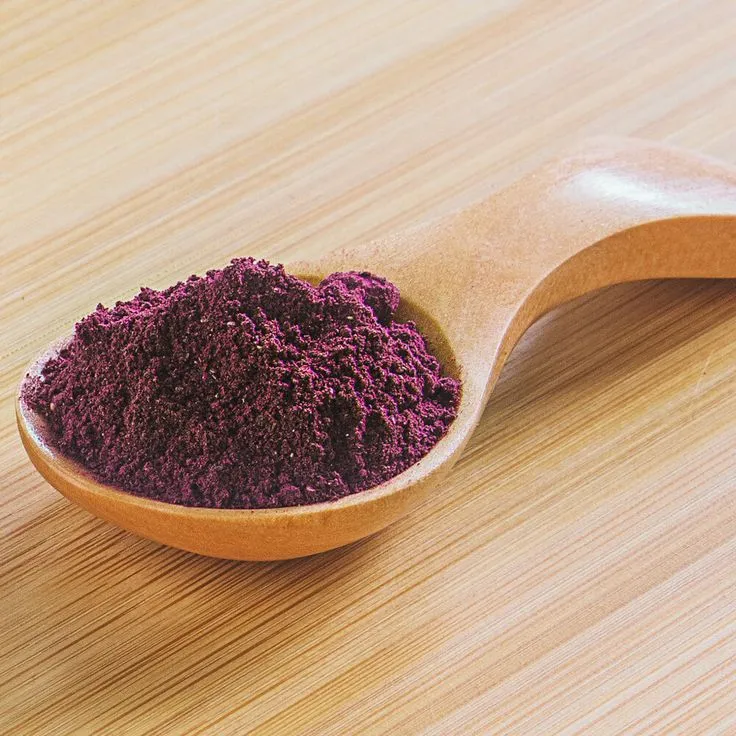
Black carrot dye comes from dark veggies to give foods rich red, deep purple and blue-red shades. We squeeze it right from dark carrot roots. It works great for plant-based food lines. But the success of its application is dependent on the food matrix, the characteristics of the pigment, processing conditions, dosage and storage conditions.
Understanding Black Carrot Concentrate
Black Carrot Concentrate is made from varieties of carrots that have a high concentration of naturally occurring anthocyanin pigments. The dark red, purple and related colors that are associated with the ingredient are due to these pigments.
The color produced will depend on the concentration, formulation and application. The concentrated sample can look quite dark when added to a food product.
Therefore, manufacturers should consider the ingredient at realistic dosage levels in the intended formulation.
How Black Carrot Color Works
Black Carrot color can give a range of red and reddish-purple to deeper purple shades. It is very dependent on the formulation environment and the end product appearance.
The colors derived from anthocyanins can change color based on the pH of the product, so pH needs to be taken into consideration when developing the product. The same ingredient can give different visual effects in different formulations of various acidity.
The direct testing of the color in the final product gives the manufacturer an idea of the color that can be achieved.
Suitable Food Applications
The use of black carrot coloring can be considered in a number of food categories such as beverages, confectionery, desserts, dairy products, sauces, fruit preparations and other formulated foods.
These requirements may vary greatly from one application to another. An excellent dispersion in an aqueous system may be required for a beverage, and a concentrated sugar system with heat may be required for confectionery products.
When using a frozen dessert, there are additional concerns about freezing and storage. Therefore, manufacturers should consider the full application before choosing the ingredient for the shade.
Consider pH During Formulation.
When assessing anthocyanin-based natural colors, pH is an important factor. Alterations in acidity can affect the shade and color performance.
The ingredient should be tested at the desired pH of the final product. If the formulation is still in development, testing over a practical pH range could provide product developers with an understanding of how the color will behave with the possible changes in formulation.
This information may be particularly helpful in formulation of sauces, confections, acidic beverages, and fruit products.
Evaluate Processing Conditions
Natural color performance may be affected by processing conditions. Product development should take into account the heating, mixing, pasteurization, baking, freezing and other production processes.
Colors that seem appropriate prior to processing can change after heat or other manufacturing processes. The length of the processing can also influence the final appearance.
Important commercial processing stages should be simulated in laboratory trials as far as possible. This provides manufacturers with a more realistic idea of the performance of the ingredient in production.
Review Color Strength and Dosage
The strength of the color should always be tested in conjunction with dosage. The same shade can be obtained with a smaller amount of a concentrated ingredient than with a larger amount of another preparation.
But the lowest dose does not necessarily imply the best dose. When selecting a shade, dispersion, formulation compatibility, processing performance and appearance in storage should all be considered by manufacturers.
Several dosage levels may be tested to find the practical dosage required for the final product and to ensure that the color is uniform.
Check Format and Dispersion
Natural colors may be provided in various forms such as powder, liquid, concentrate and other preparations. Depending on the food system and manufacturing process, the format will vary.
Before choosing a product, manufacturers should examine dispersion, solubility, concentrations, handling instructions and recommended applications.
Good dispersion is necessary throughout the formulation since uneven dispersion can lead to non-uniform colors and less uniformity in the finished product.
Assess Storage and Packaging
When assessing black carrot derived color, storage conditions should also be taken into account. The look of naturally coloured products can be affected by light, temperature, oxygen, packaging and storage time.
Transparent packaging can result in greater light exposure during transit and in the retail environment. When carrying out stability trials, manufacturers should take into account the actual packaging situation.
Sample evaluation at various storage times can facilitate the determination of color changes and aid in making sound choices regarding the ingredient and packaging system.
Conclusion
The coloring obtained from the black carrots can be useful for the production of red and purple colorings for various food products. It is important to understand the food matrix, pH, dosage, processing conditions, physical format, packaging and storage environment for its successful application. Practical trials under realistic production conditions can be used to help verify if the ingredient is suitable for the desired purpose. FoodRGB.com is a great resource for manufacturers interested in natural food coloring solutions, as they can read about the different options available and talk to a technical partner about their particular formulation requirements.